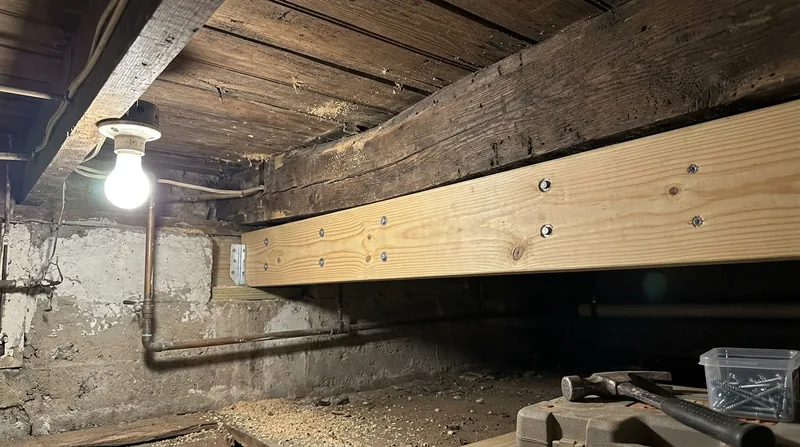




A bouncy, soft or sloping floor in an older Aurora house usually tells a story that starts in the basement below it. Old leaks from ice dams and snowmelt, carpenter ants tunneling through century-old wood, and floor joists originally sized for lighter loads all converge over decades to weaken the structure that holds up your kitchen, bedroom or living room. Floor joist and subfloor repair in Aurora is not cosmetic work. It restores the foundation of your home and stops the damage from spreading deeper into the frame. We replace or reinforce failing joists, rebuild soft subfloor sections, and bring the floor back to level before any finish goes down. Whether your home sits in the Tanner Historic District above the Fox River, in Riddle Highlands with its Sears kit homes, or in one of the brick bungalows on the Near Eastside, the freeze-thaw cycles and humid summers of the Fox Valley exact a real toll on wood. We know the pathology, and we know how to fix it right.
Why Floor Joist and Subfloor Failure Matters in Aurora's Older Homes
Aurora's building stock spans 170 years, from 1850s Italianate mansions to 1990s two-story colonials. The older the house, the more likely its floor framing is undersized by modern standards and weakened by time. Ice dams and snowmelt from our cold winters soak the sill plates and rim joists that sit closest to the foundation. Humid summers feed wood rot. Carpenter ants exploit the softened wood and hollow it out from inside. A floor that feels soft underfoot or slopes slightly toward one wall is not a minor issue. It means the joists are losing their strength, the subfloor is losing its rigidity, and the entire floor system is working harder to support everyday loads. Left unrepaired, a compromised floor can sag further, crack plaster and drywall above it, and eventually require much more expensive structural work. Addressing it early stops the decay and restores the floor to safe, level operation.
- Soft or bouncy subfloor sections indicate rot or water damage that will spread if not removed and replaced.
- Sloping or unlevel floors often originate from failed joists or rim joists that have lost bearing capacity.
- Carpenter ant galleries and termite damage visible in the basement or crawlspace are signs of active or past decay in the joists above.
- Ice dam damage to fascia, soffit and sill plates frequently extends into the floor framing and requires inspection from below.
- Sistering or reinforcing sound joists next to failing ones restores load distribution and stops the sag from worsening.
Catching floor framing damage early and repairing it prevents cascading failures throughout the rest of your home's structure.
Key info: Many homeowners in Aurora discover floor joist rot only after noticing a soft kitchen floor or a door that swings open on its own. The damage usually began years earlier, hidden in the basement or crawlspace. An inspection from below is the fastest way to see what's actually happening and to plan the repair before the problem grows.
For guidance on permits and structural work in Aurora, contact your local building department. Structural repairs often require a permit, and requirements vary by scope and location.
How We Repair Floor Joists and Subfloor in Aurora
Our process starts with a careful inspection from the basement or crawlspace. We identify which joists are sound, which are compromised by rot or insect damage, and which sections of subfloor need replacement. We then explain the options: replace the entire joist if it has lost too much wood to be trustworthy, or sister a new joist alongside it if the existing joist is still structurally viable. We rebuild soft or rotted subfloor with new plywood or tongue-and-groove lumber, ensuring proper fastening and support. We level the floor as we go, using shims and bearing adjustments so that doors close properly and water doesn't pool. The work is done from below whenever possible, so your floors, finishes and walls stay undisturbed. Related structural issues, such as wood rot in sill plates or rim joists, are addressed as part of the same repair scope.
- We inspect the full span of affected joists and subfloor from the basement or crawlspace to assess the extent of damage.
- We remove and dispose of rotted or severely damaged wood and replace it with pressure-treated lumber sized to match the existing frame.
- We sister new joists alongside failing ones when the existing wood is salvageable, securing them with lag bolts and blocking.
- We replace compromised subfloor with new material and ensure all fasteners are tight and properly spaced.
- We level the floor by adjusting shims under bearing points and sistered joists so the finished floor is flat and doors operate smoothly.
- We leave the basement or crawlspace clean and document the work for your records or insurance claim.
The entire repair is completed from below, preserving your finished floors and the rooms above.
Real example: A homeowner in Batavia noticed her kitchen floor was soft near the sink and sloping toward the exterior wall. Our inspection found three joists with significant rot from years of ice dam leaks through the rim joist. We removed the rotted wood, sistered new joists alongside the two that were still sound, and replaced the soft subfloor. The floor was back to level and rigid within three days of work. She later had her roof and fascia repaired to prevent future ice dam damage, and we helped her document the floor repair for her homeowner's insurance.
For more on structural carpentry and how we approach frame repairs, see our framing and structural carpentry service page.
Floor Joist and Subfloor Repair Methods
| Approach | Description | Best for |
|---|---|---|
| Full joist replacement | Remove the damaged joist entirely and install new pressure-treated lumber of the same dimension and grade. | Joists with rot or insect damage affecting more than 30 percent of the cross-section, or joists that have lost bearing capacity. |
| Sistering | Install a new joist alongside the existing joist and secure them together with lag bolts and blocking, creating a stronger composite beam. | Joists with moderate rot or damage that are still structurally sound in the majority of their length, and where removing the old joist would be disruptive. |
| Subfloor patch and replacement | Remove soft or rotted subfloor sections and install new plywood or tongue-and-groove lumber, securing to the joists with ring-shank or structural screws. | Localized rot or water damage in the subfloor where the joists below are still sound and can provide adequate support. |
| Floor leveling and shimming | Adjust bearing points and install tapered shims or blocking to restore the floor to level and eliminate sag or slope. | Floors that have settled unevenly or developed a slope due to joist settlement or foundation movement, as the final step after structural repairs. |
| Rim joist and sill plate repair | Remove and replace rotted rim joists and sill plates, often caused by ice dam leaks or ground moisture, and seal the new wood to prevent future water entry. | Rot at the perimeter of the floor system where ice dams, snowmelt or foundation moisture have damaged the rim joist or sill plate. |
Floor Joist and Subfloor Repair Cost in Aurora: What to Expect
Floor joist and subfloor repair in Aurora starts at around $1,800 for a localized repair involving one or two joists and a small area of subfloor replacement. The cost scales with the number of joists that need work, the extent of rot or damage, the size of the subfloor section to replace, and the accessibility of the work area. A three-joist repair with subfloor replacement in a typical basement or crawlspace usually runs $3,500 to $6,000. Full rim joist and sill plate replacement, which often accompanies floor joist work in older Aurora homes, adds another $1,500 to $3,000 depending on the linear footage affected. Access, species of wood, and the need to temporarily support the floor above all influence the final number. Getting two or three estimates from qualified carpenters is the best way to understand what your specific repair will cost and what options are available. We recommend visiting our full pricing overview to see how other structural repairs are priced and to understand the factors that move costs up or down.
We provide free, no-obligation estimates within 24 hours. Call us at (815) 916-4993 or request an estimate online and describe what you're seeing in your floor. We'll schedule an inspection and give you a clear price for the repair.
Floor Joist and Subfloor Repair Near Me: What Aurora Homeowners Should Know When Hiring a Carpenter
When you're looking for a carpenter to repair floor joists and subfloor in Aurora, a few things matter more than price alone. First, make sure the contractor is fully insured and can show you proof of general liability and workers compensation coverage. A contractor working on your structural framing should carry at least $1 million in liability insurance. Second, ask for references from recent jobs of similar scope and call them. A floor joist repair is structural work, and you want to hear from homeowners who had it done and are happy with the result. Third, get two or three estimates from different contractors. Don't just pick the lowest bid. Look for a contractor who explains what they found, why the repair is necessary, and how they'll do it. Fourth, understand that structural repairs often require a permit from the Aurora building department. Ask your contractor whether a permit is needed for your specific repair. Some homeowners worry about permits, but they exist to ensure the work is done safely and to your local code. A contractor who avoids talking about permits is a red flag. Fifth, if your home is in a historic district like the Tanner Historic District, check with the city or your homeowners association about any approval requirements before work begins. Finally, ask the contractor to document the repair with photos and measurements. This documentation is valuable for your records and can help support an insurance claim if the damage was caused by a covered loss.
- Verify that the contractor carries full insurance and can provide a current certificate of liability coverage.
- Ask for at least three references from homeowners who had floor joist or structural carpentry work done in the past two years.
- Get written estimates from two or three contractors that detail what will be replaced, what will be repaired, and the timeline.
- Confirm whether a permit is required and whether the contractor will handle the permit process or if you need to apply yourself.
- Ask about how the contractor will support the floor during the work and what disruption to your home to expect.
- Request that the completed repair be documented with photos and a summary of the work performed for your records.
Choosing a carpenter who communicates clearly, carries insurance, and understands the local building code is the best way to ensure your floor repair is done right and lasts.


